
Private Basketball Training for Kids: Is It Worth It?
Your kid’s rep season just started. Two practices a week, a tournament every other weekend. And somewhere between the 7 a.m. drive to Markham and the 9 p.m. drive home, you started wondering if it’s enough.
Then another parent in the bleachers mentions their son does private sessions on Sundays. Now you’re wondering if your kid is falling behind.
I get this question every fall. Is private basketball training for kids worth the money, or is it just the newest thing GTA parents feel pressured into? I raised three boys who all played at the university or prep level, and I have run Elite Camps for 27 years.
Here’s my answer: sometimes it’s the best money you’ll spend. Sometimes it’s a waste. The difference is timing, the trainer, and what your kid actually needs.
Why Parents Look at Private Basketball Training for Kids
Most parents come to private training for one of three reasons.
Their kid got cut, or barely made the team, and they want to close a gap before next year. Their kid made the team but sits a lot, and they want more minutes. Or their kid is already strong and they want an edge.
All three are fair. But notice something: every one of those reasons is about the team. Private training works best when you stop thinking about this season’s roster and start thinking about the player your kid will be at 16.
The 300 Rep Rule: Where Team Practice Falls Short
Here’s the math nobody explains at the rep parent meeting.
A 90-minute team practice with 12 kids gets split between warm up, team defence, set plays, and scrimmage. Your kid might take 25 shots. Maybe 20 real dribble moves against pressure. That’s not a knock on the coach. A team practice is built to make a team work, not to rebuild one kid’s shot.
Confidence comes from repetition. You cannot shortcut 300 reps. The kid who has made the same move 300 times in a quiet gym is the kid who trusts it in the fourth quarter.
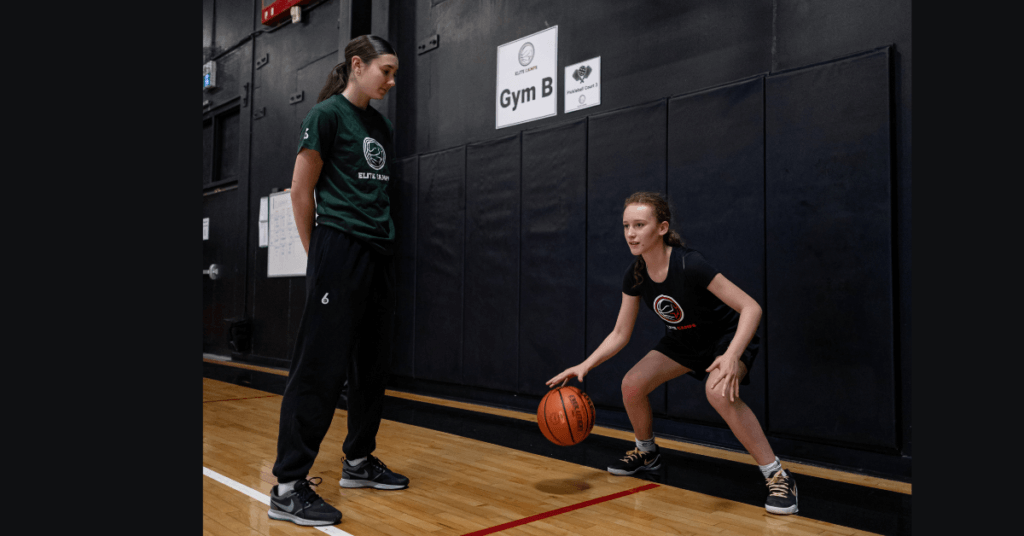
In a private session, your kid touches the ball constantly for the full hour. The coach sees every rep and fixes the small stuff in real time: the elbow flaring out, the eyes dropping on the dribble, the lazy off hand. That kind of feedback almost never happens with 11 other kids waiting in line.
What 1-on-1 actually fixes
Private training is a scalpel, not a sledgehammer. It works best on one specific thing:
- A shot that breaks down past 12 feet
- A weak hand the other team keeps forcing them to
- Finishing through contact instead of avoiding it
- Footwork that falls apart at game speed
If you can’t name the one thing, you’re not ready for private training yet. Ask your kid’s coach first.
When Private Training Is Worth It (And When It Isn’t)
I’ll be direct, because I’ve watched a lot of families spend a lot of money on the wrong thing.
It’s worth it when:
Your kid is 10 or older and asking for it. The motivation has to come from them. A 12-year-old who wants to fix their jump shot will get more out of four sessions than a reluctant kid will get out of forty.
There’s a specific, nameable skill gap. “Get better” is not a goal. “Make 7 of 10 from the elbow by March” is.
They already have the basics. Private training builds on a foundation. It doesn’t replace one.
It’s not worth it when:
Your kid is 7 and just learning to love the game. At that age, they need fun, friends, and lots of touches in a group. That’s where weekly lessons fit.
The trainer rebounds and runs your kid into the ground. Exhaustion is not development. If your kid walks out drenched but can’t tell you one thing they learned, that session was a workout, not training.
It’s replacing play. Kids still need to scrimmage, make decisions, and mess up in real games. Skills learned alone have to get tested with other players.
Canada’s Sport for Life framework makes the same point about long-term development: kids grow best through a mix of skill work and play, matched to their age and stage. Private training is one piece of that. It shouldn’t be the whole thing.
Let Them Struggle: Private Training Isn’t a Rescue
This is the part that’s hard for parents. It was hard for me.
When your kid is sitting on the bench, your instinct is to fix it. Book the trainer. Email the coach. Make the discomfort go away.
But the bench is doing some of the teaching. Your kid is learning what it feels like to want something they haven’t earned yet. If private training becomes the way you rescue them from that feeling, you’ve stolen the lesson.
Here’s the difference. A parent who says “You’re getting a trainer because the coach doesn’t see you” teaches their kid the problem is someone else. A parent who asks “What do you want to get better at, and do you want help with it?” teaches ownership.
My boys didn’t all love their coaches. They didn’t all get the minutes they wanted. The years they grew the most were the years they decided on their own that they wanted to put in extra work. My job was to drive them to the gym, not to make the struggle disappear.
Let your kid feel the gap. Then let them choose to close it.
Private vs. Semi-Private: Which One Fits Your Kid?
Not every kid needs a trainer all to themselves. For a lot of families, semi-private basketball training is the smarter first step.
Private (1-on-1) is best for a very specific fix, an older player (13+) with a clear goal, or a kid who gets self-conscious working in front of peers. At Elite, our private basketball training is for ages 10 to 15, one hour a week, built around one focus: Shooting, Ball Handling, or Attack the Basket. All skills, no game time.
Semi-private (4 athletes, 1 coach) gives your kid nearly the same feedback with a little healthy competition built in. Kids push harder when someone next to them is making shots. It’s for ages 10 to 16, and it’s a great next step for kids coming out of weekly lessons, D-League, or summer camp, including rep players who want skill work their team schedule doesn’t cover.
If you’re looking for private basketball lessons in Toronto or Richmond Hill, whatever program you choose, ask these three questions before you pay:
- Are the coaches paid and trained, or is it one person with a gym key?
- Is there a set curriculum, or does every session look different?
- How will you measure progress in 6 weeks?
If you get vague answers, keep looking.
The Takeaway
Private basketball training for kids isn’t magic, and it isn’t a status symbol. It’s a tool. Used at the right age, for the right reason, with the right coach, it can speed up a kid’s skill development in a way team practice simply can’t.
Start with the one skill. Make sure your kid wants it. Pick paid, trained coaches with a real curriculum. Then get out of the way and let them do the work.
Fall private and semi-private sessions are running now in Toronto and Richmond Hill. See our private and semi-private training options or register here.
P.S. Not sure your kid is ready for private work? Read How to Get Better at Basketball: What Actually Helps Kids Improve first. It’ll help you figure out where your kid is right now, and what the next right step looks like.

About the Author:
Stephanie Rudnick
Founder of Elite Camps & Author of the Lil Baller Book Series
Stephanie Rudnick is the founder of Elite Camps, one of Canada’s largest basketball organizations, and the author of the beloved Lil Baller book series & Life is a Sport. With over 25 years of experience, Stephanie has dedicated her life to teaching kids the skills and values they need to thrive both on and off the court, while also serving as a trusted resource for parents navigating the ups and downs of youth sports.
A former University basketball player, Stephanie has transformed her own experiences as an athlete and parent into actionable advice for families. Her books, camps, and speaking engagements focus on fostering resilience, confidence, and joy in young athletes while empowering parents to guide their children through the challenges of sports with confidence and positivity.
Stephanie’s mission is to create a supportive community where kids and parents alike feel equipped to embrace the lessons sports can offer—both in the game and in life.


