
Rep Basketball in Ontario: What Every GTA Parent Needs to Know Before Tryouts
Rep tryouts are coming up, and if you’re standing in a gym parking lot at 9pm googling “is my kid ready for rep basketball,” you are not alone. I get that question more than any other question I get asked.
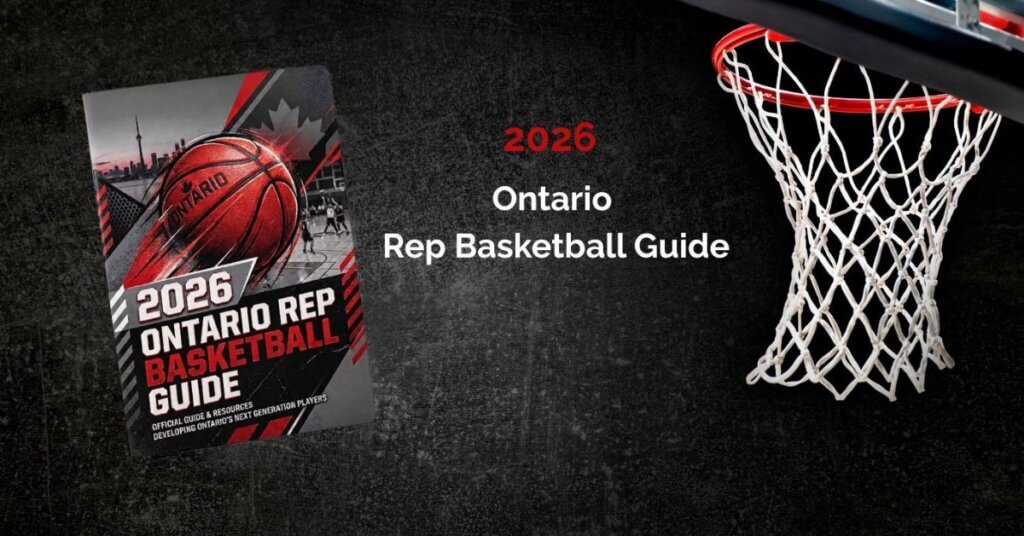
I wrote the full breakdown in our 2026 Rep Basketball Directory & Parent Guide, but here’s the short version. Rep basketball in Ontario runs on a system most parents never get handed until they’re already three tryouts deep. Age divisions, cost structures, coach politics, the whole thing. Let’s walk through what actually matters.
The Age Groups Aren’t What You Think
Ontario Basketball builds its programming around three development stages, not just age. Learn to Train covers U9 to U12: smaller ball, shorter free throw line, skill over scoreboard. Train to Train is U13 to U14, where kids start specializing and full rules kick in. Train to Compete is U15 to U19, where shot clocks and real recruiting stakes show up.
Inside those stages, teams also get ranked by division, A through the alphabet, with A being the most competitive. A U11 Division A team and a U11 Division M team are technically the same age group. They are not the same room. Watch a team actually play before you commit your kid to that room.
Is Your Kid Actually Ready, or Are You?
Here’s the tell I trust more than any tryout evaluation: who’s driving the ask?
If you’re the one googling rep basketball in Ontario and your kid is shrugging in the back seat, that’s information. I look for kids who ask for extra reps, not just extra games. Kids who can lose and still want to play tomorrow. Kids who can hear a coach say “run it again” without hearing “you’re not good enough.”
Readiness isn’t a skill test. It’s an appetite test. I’ve watched average nine-year-old shooters thrive in rep because they were hungry for the work, and gifted twelve-year-olds burn out in one season because the fire was ours, not theirs.
What Rep Basketball in Ontario Actually Costs
Nobody hands you this before your kid makes a team, and then you get the invoice. Season fees vary by club, but two things quietly drive the number up every year: multi-league play, where a team enters two or three leagues instead of one for extra exposure, and paid coaching, which is becoming standard even though it’s rarely spelled out up front.
Ask the club what registration costs. Then ask a current parent what they actually spent all-in last season, including travel, extra leagues, and training. Clubs know their fee. Only parents know the real number.
What to Look for in a Coach and a Team
Watch a practice before you sign anything. Is the coach’s energy going to the whole bench, or just the kids who’ll get them a trophy? Do they separate the player from the performance when a kid has a bad quarter? A demanding coach is fine. A demanding coach who respects the kid underneath the pressure is the one worth staying for.
For the team itself, ask about playing time philosophy and practice-to-game ratio before September, not in March. Then talk to a bench player’s parent, not just a starter’s. That’s the honest read on culture.
If They Get Cut, This Is Where Your Job Starts
My son Jeremy got cut in grade 9. It gutted him, and honestly, it gutted me more. That cut is the reason he got serious. He put in hours nobody made him put in, and today he plays university basketball at Laurier.
Most of the starters on his grade 8 rep team never played another organized minute after high school. A cut at 14 doesn’t predict anything about 18. What predicts it is what your kid decides to do the week after. Let them feel it first. Don’t rush to fix it with a pep talk in the first ten minutes. Then help them find the next gym.
Where Elite Camps Fits In
We’re not a rep club, and we’re not trying to be. Elite Camps is a teaching company. We’re not managing anyone’s playing time or protecting a roster spot. We just work on making your kid better, whichever club or league they play in.
That means Elite Camps works alongside your rep team, not against it. Your club owns the games and the season. We own the individual reps a team practice rarely has time for: ball handling, shooting mechanics, footwork, the stuff that actually shows up at tryouts.
The Bottom Line
Rep basketball in Ontario will test your kid, and it’ll test you too. That’s not a flaw in the system, it’s the point. Every tryout and every hard bench night is building grit that outlasts the season.
I put everything, the full division breakdown, the real cost structure, the tryout playbook, and a region-by-region directory of every rep club in Ontario, into one guide. Grab the free 2026 Rep Basketball Directory & Parent Guide here: 2026 Rep Basketball Directory & Parent Guide.
P.S. If your kid needs in-season reps to hold their spot, or needs a gym that still believes in them after a tough tryout, check out our skills training programs. And if you’re still deciding between rep and camp altogether, start here: Is a Rep Team or Basketball Camp Better for Your Kid?

About the Author:
Stephanie Rudnick
Founder of Elite Camps & Author of the Lil Baller Book Series
Stephanie Rudnick is the founder of Elite Camps, one of Canada’s largest basketball organizations, and the author of the beloved Lil Baller book series & Life is a Sport. With over 25 years of experience, Stephanie has dedicated her life to teaching kids the skills and values they need to thrive both on and off the court, while also serving as a trusted resource for parents navigating the ups and downs of youth sports.
A former University basketball player, Stephanie has transformed her own experiences as an athlete and parent into actionable advice for families. Her books, camps, and speaking engagements focus on fostering resilience, confidence, and joy in young athletes while empowering parents to guide their children through the challenges of sports with confidence and positivity.
Stephanie’s mission is to create a supportive community where kids and parents alike feel equipped to embrace the lessons sports can offer—both in the game and in life.